


What is Lithium Battery Low Voltage?
Lithium-ion batteries should not be depleted below their minimum voltage, which is typically between 2.4–3.0 volts per cell. The low voltage cut-off (LVC) is the minimum voltage at which a battery is safe to discharge, and it helps prevent over-discharge, which can damage the battery and reduce its lifespan.
Why Choose Us
Our Factory
Yangzhou Huizhi New Energy Co., Ltd., established in 2023, is a young new energy enterprise.
Production Market
Our products are sold to most Europe countries, especially in Germany, also in South Africa and West Africa.
Our Product
Household lithium battery pack, All in one energy storage system for Industrial and Commercial, Containerized ESS.
Our service
Fantastic services ---- Fast response, Professional design solutions, Careful guidance and Perfect after-sales support.
-
![Low Voltage Lithium Ion Battery Systems]() Low Voltage Lithium Ion Battery SystemsThis low voltage lithium iron battery is a standard battery system unit developed by HuiZhi New Energy Co.,Ltd. The product is especially suitable for energy storage applications with high operatingread more
-
![Stackable Lithium Power Pack]() Stackable Lithium Power PackThis is our low voltage home Stackable lithium power pack. There are four battery packs, each battery pack is 5KWh, the total capacity is 20KWh, if you need more energy, we can add another 5KWh, theread more
-
![Lithium Iron Phosphate Battery 48v 100ah]() Lithium Iron Phosphate Battery 48v 100ahThe lithium iron phosphate battery 48v 100ah is a compact house lithium battery that stores energy generated by solar or from the grid. You can use this energy to power the devices and appliances inread more
-
![Low Voltage Lithium Battery]() Low Voltage Lithium BatteryThis lithium iron phosphate battery is a type of lithium battery packs known for its high performance, long lifespan, and relatively high safety. lifep04 lithium battery find widespread applicationsread more
-
![Wall Mounted Lithium Battery pack]() Wall Mounted Lithium Battery packThis wall mounted lithium battery is a standard battery system unit, customers can choose a certain number of lithium ion po4 battery according to their needs, by connecting parallel to from a largerread more
-
![industrial lithium ion battery packs]() industrial lithium ion battery packsThis lithium ion battery packs are a standard battery system unit developed by HuiZhi New Energy Co.,Ltd. The product is especially suitable for Wheelchairs and scooters, Solar/wind energy storage,read more


All Li-ion cells, including the Li-ion cells contained in Mobile Power Centers, are sensitive to voltage. A Prolonged low voltage condition within a Li-ion cell may cause the dissolution of metals (principally copper). Copper dissolves into the electrolyte solution at open circuit voltages below ~0.7 volts. This dissolved copper is re-plated within the cell upon subsequent charging and can cause undesirable effects and almost certainly will compromise cell performance (e.g. low capacity, poor cycle life, high self-discharge).
Similarly, high voltage can also cause the degradation of Li-ion cells, especially at elevated temperature. When a Li-ion battery is plugged into a charger, charging continues along a prescribed path until a state of charge ("SOC") of 100% is sensed by the circuitry. The charging is then terminated and the battery is allowed to very slowly discharge. It is detrimental to the cells to be kept at 98-100% SOC for prolonged periods of time (i.e. more than 10 days). This is why many cells are allowed to discharge to around 95% SOC or less before charging is re-initiated, even while connected to a charger.
The nature of Li-ion cells is such that the relationship between state of charge ("SOC") and voltage is fairly flat throughout much of the cell's discharge range. A typical discharge voltage curve is shown below:
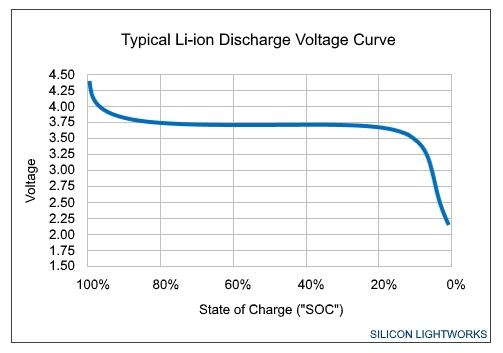
The rapid fall of voltage at the end of the discharge cycle provides a relatively accurate means of determining when energy will run out. However, this also means that the SOC drops much more rapidly and can lead to an over-discharged condition if the cell or battery is left to sit for prolonged periods at a low SOC. This is due to the fact that Li-ion cells have an inherent self-discharge rate independent of any circuit load. This self-discharge rate is quite low at room temperatures around 20-25°C or less. Values of around 2% per month are typical. However, this rate can more than double when cells are exposed to high temperatures. Furthermore, ambient temperature can have a profound effect on the discharge voltage curve and must be considered during transportation and storage when the cells may be exposed to extreme high or low temperatures.
Well-designed lithium ion batteries, such as those from Silicon Lightworks, include safety circuits that protect cells from both high and low voltage conditions. However, inherent self-discharge within the cells can lead to a low voltage condition if the cells are left uncharged for long periods of time. As such, we recommend fully cycling your Mobile Power Center at least once every six months and then recharging to a SOC of approximately 30-70% (i.e. until 2 or 3 indicator lights are illuminated on the fuel gauge of the Mobile Power Center). This will ensure maximize battery performance and increase battery life.
What Is the Stackable Battery System Used For?
Demand for renewable energy has skyrocketed in recent years due to growing concerns over climate change and the need for sustainable energy. Therefore, much attention has been paid to developing efficient energy storage solutions that can store and supply power on demand. One of these breakthrough technologies is the stackable battery system, which offers a promising solution for energy storage applications. In this blog, we explore what stackable battery systems are and how they can revolutionize energy storage.
Learn about stackable battery systems:
Stackable battery systems refer to modular energy storage units that can be combined with other similar units to form larger systems. These systems are designed to be stackable both vertically and horizontally, allowing customization to the specific requirements of various applications. The modularity of the stackable battery system provides flexibility and scalability, making it highly adaptable to various energy storage needs.
Applications of stackable battery systems:
Household energy storage: Stackable battery systems are widely used in residential applications where homeowners can benefit from storing excess electricity generated by solar panels or other renewable sources. Stacked batteries store power during the day and release it when needed, ensuring continuous power supply. Not only does this reduce reliance on the grid, it also helps homeowners save on energy bills.
Commercial and industrial applications: Stackable battery systems have important applications in commercial and industrial areas where large amounts of energy need to be stored and readily available. These systems provide uninterruptible power supply (UPS) solutions to ensure uninterrupted operation, protect sensitive equipment, and mitigate the effects of power outages. In addition, stackable battery systems are used for load balancing, peak shaving, and demand response in industrial environments.
Electric vehicle charging infrastructure: With the increasing popularity of electric vehicles (EVs), the need for efficient charging infrastructure increases. Electric vehicle charging stations use stackable battery systems to store power during off-peak hours and supply power during peak demand periods, effectively managing grid load. This enables EV owners to charge faster and more reliably while optimizing energy consumption and reducing stress on the grid.
Advantages of stackable battery systems:
Scalability: The modular design of the stackable battery system can be easily expanded and customized, ensuring expansion according to different energy needs.
Flexibility: The ability to stack cells vertically and horizontally makes these systems flexible and adaptable to different spaces and constraints.
Redundancy: Stackable battery systems provide redundancy, which means that if one battery module fails, the remaining batteries will continue to function, significantly increasing the reliability of the system.
Cost-effective: By storing surplus electricity during periods of low demand, stackable battery systems can reduce reliance on expensive grid energy, saving costs over time.
Environmentally Friendly: By integrating renewable energy and reducing dependence on fossil fuels, stackable battery systems contribute to a greener, more sustainable future.
The composition of a low-voltage energy storage battery Pack mainly includes a single battery module, an electrical system, a box, and BMS several major parts.
If the battery pack is compared to the human body, the battery module can be regarded as the heart, which is responsible for storing and releasing electric energy; the electrical system can be regarded as the arteries and blood vessels and the nerve network, which continuously delivers the battery electric energy to the end loads and transmits the detection and control signals in real-time; the case can be regarded as the skeleton, which plays a role in supporting, resisting the mechanical impacts and protecting the environment; and the BMS can be regarded as the brain, which is responsible for measuring parameters such as voltage, current, temperature, etc. of the battery. BMS (Battery Management System) can be regarded as the brain, which is responsible for measuring the battery's voltage, current, temperature and other parameters.
The basic principle of the low-voltage lithium battery pack is based on the electrochemical property of redox reaction. When charging, lithium ions form LiCoO2 or LiFePO4 in the positive electrode material (e.g. LiCoO2 or LiFePO4), and at the same time, in the negative electrode material (e.g. graphite), lithium ions enter the metal graphite from the electrolyte and are reduced to lithium atoms. When discharged, the lithium ions will inversely return to the battery to form LiFePO4 or LiCoO2 and be oxidized to lithium ions at the same time.
Low-voltage storage lithium battery Pack process mainstream advanced laser welding and ultrasonic welding two ways, laser welding is the use of high energy density laser beam as a heat source of a highly efficient precision welding method. Ultrasonic welding is the use of high-frequency vibration waves transmitted to the surface of two objects to be welded, under pressure, so that the surface of the two objects to friction between each other and the formation of fusion between the molecular layers.

High Voltage vs Low Voltage Batteries
Battery systems are a great compliment for a solar pv system. They allow energy to be stored for use when the sun is not shining. But which type of battery system is best? This is not something that has a one size fits all answer. There are multiple categories that batteries can fall into.Today we are going to look at the difference between high and low voltage batteries. There are different applications for each of these systems and they both have very apparent strengths and weaknesses.
Low voltage battery banks typically are keeping their voltage below 100V. Multiple battery modules are linked together in parallel (if the rated voltage is compatible with the inverter) or series (to increase the voltage).
For example: Two 24V batteries in series would result in a battery system voltage of 48V. Low voltage systems have higher amperage than high voltage battery systems.
This means that the conductors connecting your batteries to the inverter must be larger (thicker). These systems tend to be a little safer to work with due to the lower voltage and are much easier to scale. Typical battery inverters that are rated at 48V tend to handle large battery banks as well.
These low voltage systems tend to have trouble covering those quick, startup loads. A lot of the time, the battery system will need assistance from the grid or solar to supply enough instant power to the device that is trying to start (for example, a well pump). This is one of the major drawbacks to low voltage battery systems and is constantly being designed around. Low voltage systems are much easier to install and upgrade. They tend to have smaller physical individual units to allow for custom sizing.
High voltage battery systems are usually rated around 400V. These systems are able to charge and discharge faster than the low voltage batteries and can cover those quick demand surges from starting equipment. These batteries do not need large conductors because their voltage is so high.
The amperage running to the inverter from the battery is significantly lower than the low voltage battery systems. The battery inverters associated with high voltage batteries tend to allow for connections of around 3 batteries. This is significantly lower than the low voltage battery systems, however, the individual battery banks are larger for the high voltage systems.
High voltage systems are better for peak shaving applications where the battery is utilized every day. Installations with exceptionally large demands should utilize high voltage systems as well. Low voltage systems are better for off grid applications and people who are looking for large battery banks with medium to low demand. Low voltage systems take up more space and can have many more connections compared to a high voltage system. This leads to more "moving parts” and can result in more difficult troubleshooting items.
Overview of Lithium-Ion Battery Stacking Technologies
Lithium-ion battery stacking technologies can be broadly categorized into four main types: Z-fold stacking, cut-and-stack integration, thermal composite stacking, and roll-to-stack integration. Among these, Z-fold stacking and cut-and-stack integration are commonly used in domestic applications. Thermal composite stacking offers enhanced quality and production speed but involves higher technical complexity.

Z-Fold Stacking Technology
Z-fold stacking technology is one of the most common stacking methods. It involves moving the separator between stacking platforms in a zigzag pattern, allowing the anode and cathode tabs to cross-stack.
Z-fold stacking has certain drawbacks, including separator deformation and low stacking efficiency. Separator deformation can occur due to the swinging motion of the separator, resulting in asymmetry and inconsistent deformation. The varying tension during stacking leads to non-uniform stretching and deformation of the separator, affecting the battery's quality. Moreover, the stacking process is time-consuming, as it requires swinging the separator and can only achieve single-layer stacking, resulting in limited efficiency.

Cut-and-Stack Integration Technology
Cut-and-stack integration is essentially an improvement over Z-fold stacking. It aims to enhance yield rates and stacking efficiency. By consolidating multiple steps into a single machine, it reduces the risk of cell damage during transportation and handling.
Traditional production methods involve using a stacking machine to retrieve and stack sliced electrodes from a material box. During retrieval, electrodes may collide, bend, or fold. In contrast, cut-and-stack integration combines electrode cutting, Z-fold stacking, and adhesive thermal pressing into a single process. This integration eliminates bending and picking issues and, by reducing the number of steps and transfers, reduces the risk of collision and improves yield rates.

Thermal Composite Stacking Technology
Thermal composite stacking involves simultaneous cutting and stacking of the positive and negative electrodes and separator, followed by hot pressing. This technology achieves a significant improvement in stacking quality and production rates. However, it comes with greater technical challenges.
In thermal composite stacking, the electrodes and separator are simultaneously fed into a heating device. After heating, a hot roller presses the composite, cutting the separator to form individual stacking units. These units are then mechanically stacked, creating electrode assemblies.
One notable advantage of thermal composite stacking is that the separator and electrodes maintain consistent tension, direction, and speed throughout the process, ensuring uniformity. This results in a higher-quality battery. While it presents higher technical difficulty compared to Z-fold stacking, it is suitable for high-energy-density batteries.
Our Factory
Yangzhou Huizhi New Energy Co., Ltd., established in 2023, is a young new energy enterprise. Our company is committed to the production, research and development, and sales of lithium iron phosphate batteries, energy storage systems, photovoltaic systems, and related solar products, vigorously expanding the global market, aiming to make new breakthroughs and contributions to the green new energy industry for all mankind.
FAQ
We're professional lithium battery low voltage manufacturers and suppliers in China, specialized in providing high quality OEM&ODM service. We warmly welcome you to buy cost-efficient lithium battery low voltage for sale here from our factory. For price consultation, contact us.
lithium battery for spraying machines, lithium battery, lithium iron phosphate battery 48v 100ah